In this article
An ingredient percentage and a clinical response percentage describe different things. The first belongs to a formula; the second belongs to a group of people assessed under a particular rule. Moving directly from one to the other skips the experiment that connects them. Tone & Context examines that connection here, using a full melasma trial report and official prescribing information to show how a cream’s identity, a study’s design and an outcome’s definition fit together.
The useful question is more specific than whether a combination works. It is what was measured, for whom, against which alternative and over what period. Our analysis separates those questions before considering how a trial might inform a product review. We also use an original sunscreen investigation and FDA regulatory material to distinguish treatment response, measurement of appearance and product status. These distinctions help preserve the value of the evidence without turning a group result into a forecast for an individual.
Study facts at a glance
Formula identity: Tri-Luma combines hydroquinone, tretinoin and fluocinolone acetonide. Source 1
Study design: Eight-week, randomized, double-blind, single-center Chinese analysis. Source 2
Participant counts: 53 randomized; 52 analyzed; 44 completed. Source 2
Primary response rule: Reduction by two or three Melasma Severity Scale grades. Source 2
Labeled purpose: US Tri-Luma labeling specifies short-term moderate-to-severe facial melasma treatment, not maintenance. Source 1
A combination is one experimental intervention
The formulation below identifies the active ingredients and concentrations relevant to this discussion. These are descriptions of a studied topical product, not directions for assembling a cream or choosing a regimen. Reading the list as an intervention helps prevent a common attribution error: a result for the whole mixture does not tell us how much of the result each ingredient produced.
To isolate contributions, an experiment needs comparisons that can separate them. Imagine a hypothetical cream containing ingredients A and B. Comparing A plus B with a vehicle can test the combination under those conditions, but it cannot establish that A accounts for most of the benefit or that B is unnecessary. Comparisons with A alone and B alone would answer additional questions. Even then, an interaction between ingredients would require attention rather than an assumption that their effects simply add.
This is why a number next to hydroquinone should not become the complete identity of a product. The hydroquinone cream guide provides a place to organize questions about the prescription and its limits. The scientific distinction remains straightforward: evidence about an ingredient, evidence about a finished formulation and evidence about a treatment strategy occupy different levels.
Concentrations identify the combination; they are not dosing instructions.
| Ingredient | Concentration | Comparison implication |
|---|---|---|
| Hydroquinone | 4% | One component of the complete formulation |
| Tretinoin | 0.05% | The combined result does not isolate its contribution |
| Fluocinolone acetonide | 0.01% | The intervention includes a corticosteroid |
Read the underlying chart data: download CSV or download the source-labeled chart.
Follow participants through the analysis
Participants were mostly women with epidermal melasma, aged 33–55. All groups received cleanser, moisturizer and sunscreen. One untreated participant was excluded; missing follow-up used last-observation-carried-forward. That method replaces a missing later measurement with an earlier available measurement. It does not establish that the person’s condition actually stayed the same. An earlier observation is a data point; carrying it forward is an analytic decision about an unobserved period.
Think of enrollment, analysis and completion as three different denominators with three different jobs. Enrollment describes who entered the comparison. An analysis set describes whose records contributed to a calculation. Completion describes who reached the end of the scheduled observation. Combining these categories can make follow-up appear more complete than it was, or make a result look less interpretable than it is. The right denominator depends on the question, so it should be named rather than assumed.
Selection also affects what condition the result describes. A trial’s diagnostic criteria do not become a diagnostic tool for somebody viewing a photograph online. Our melasma, sun-spot and post-acne-mark guide is a companion for framing that distinction. Editorially, a review should establish which concern is under discussion before attaching a numerical outcome to the broad phrase dark spots.
A change in severity does not specify the final appearance
The Melasma Severity Scale uses grades from zero to three. A change-based response asks how far someone moves; a clearance endpoint asks where that person finishes. As an illustrative calculation, movement from three to one is a two-grade improvement but leaves a nonzero score. Movement from two to zero is also a two-grade improvement and ends at clear. The arithmetic allows both experiences to satisfy the same change-based rule.
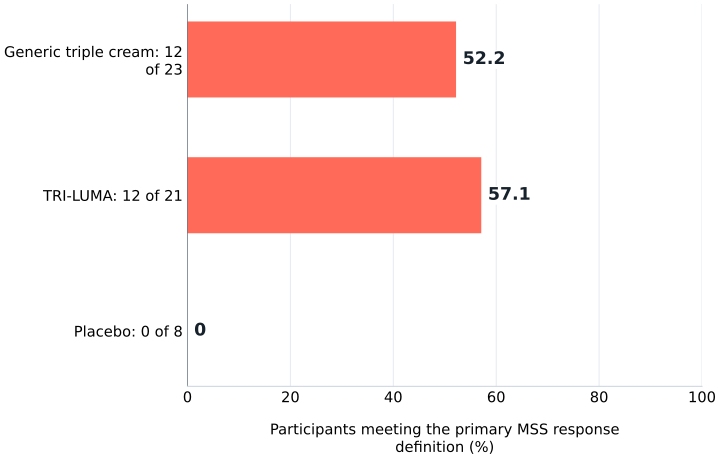
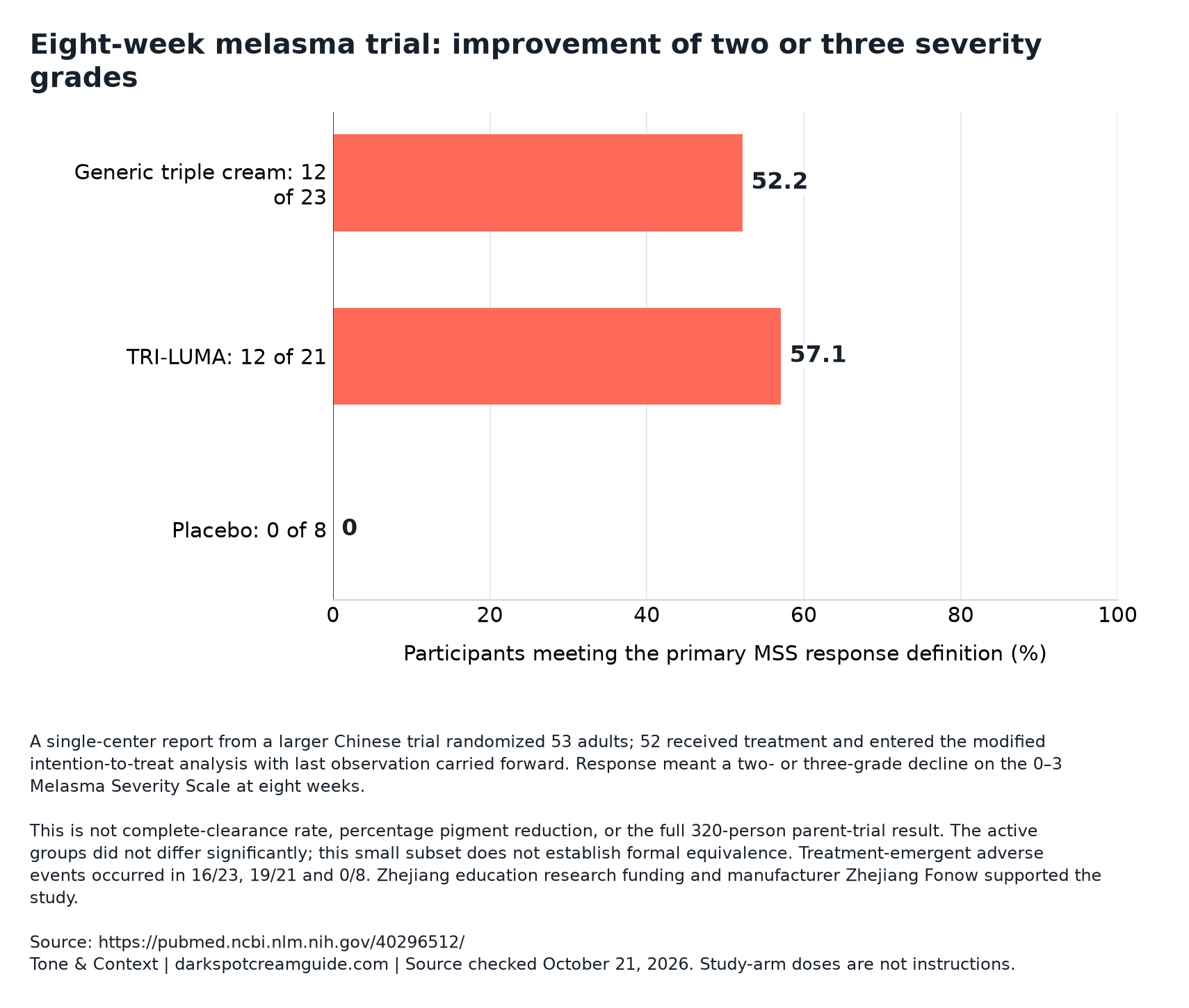
The primary results appear below with their denominators intact. The fraction describes participants meeting a rule, not the fraction of pigment removed from someone’s face. Keeping the numerator visible also prevents false precision: the decimal in a percentage does not mean that a clinical assessment measured a person’s appearance to a tenth of a percent. It comes from dividing a count by another count.
A second reading task is to distinguish a starting category from a change category. Two groups with different distributions at entry may have different routes to the response threshold even when they use the same scale. That observation does not explain any particular difference in this trial. It identifies a feature a reader should inspect before treating a response percentage as a universal property of the cream.
Primary response: improvement by two or three severity grades.
| Arm | Responders / analyzed | Response proportion |
|---|---|---|
| Generic cream | 12/23 | 52.2% |
| Tri-Luma | 12/21 | 57.1% |
| Vehicle | 0/8 | 0% |
Keep MASI averages separate from MASI responders
On the Melasma Area and Severity Index (MASI), at least 50% improvement occurred in 69.6% of generic and 81.0% of Tri-Luma participants. Mean percentage reductions were 63.2%, 72.9% and 24.7% for generic, Tri-Luma and vehicle. Those summaries describe different features of the results. One counts people on a chosen side of a threshold. The other summarizes the size of changes across people.
For a clearly hypothetical example, suppose three observations improve by 20%, 60% and 70%. Their mean improvement is 50%, while two of the three observations meet a threshold of at least 50%. Neither statement contradicts the other. Now replace those changes with 50%, 50% and 50%: the mean is unchanged, but every observation meets the threshold. This example shows why a mean cannot be translated into the number of people who responded.
The same precision applies to units. A score falling from ten to six drops by four score units and by 40% relative to its starting value. It does not fall by forty percentage points. Finally, variation among individuals and uncertainty in a group estimate need different summaries: a standard deviation describes spread, whereas a confidence interval concerns estimation uncertainty. Relabeling spread as an interval would change its meaning.
An equivalence conclusion requires its own statistical design
The active-arm difference was nonsignificant; equivalence was not established. The distinction is easiest to see by separating two objectives. A difference test looks for evidence that groups differ under a specified hypothesis and model. An equivalence analysis asks whether the data exclude differences larger than a boundary considered clinically important. The latter needs a justified boundary and enough precision to evaluate it.
Consider two hypothetical uncertainty intervals around a small estimated difference. One is narrow and stays within a previously chosen acceptable range. The other stretches beyond that range in both directions. The estimated difference could look almost identical in a chart, while the conclusions about equivalence would be very different. A point estimate alone cannot show which situation applies. Nor does a large P-value supply the missing interval or the clinical justification for a boundary.
This matters especially when a review uses words such as interchangeable or equally effective. Those words imply more than failure to detect a difference. Our interpretation is that comparison language should match the statistical question actually resolved. That discipline also leaves room for uncertainty without converting it into a negative finding: an inconclusive comparison does not prove that either formulation is inferior, just as it does not prove equivalence.
The prescribing-information studies answer a different question
The US label reports complete clearing in 32/85 (38%) and 10/76 (13%) Tri-Luma participants in separate trials against dual-active combinations. These are not the Chinese trial’s response rule or comparator. Putting all the percentages into one league table would make differences in outcome definition look like differences in performance. A valid comparison needs an explanation of the question before it needs a ranking.
An active comparator can investigate whether a complete combination offers something beyond a specified partial combination. A vehicle comparison instead evaluates a different contrast. Neither contrast automatically identifies the best choice among every product someone might encounter. The set of alternatives in the experiment defines the comparisons it can support; products outside that set require additional evidence rather than an assumed place in an ordering.
Official labeling also serves a purpose that a research paper does not replace. It provides product-specific prescribing information, including the scope and limits of the approved use. The label states that other hyperpigmentation conditions and phototypes V and VI were not studied. Those statements identify gaps. They should not be rewritten as a demonstrated benefit, a demonstrated lack of benefit or a personalized decision about someone whose circumstances were not examined.
Separate symptom counts from an overall safety judgment
Treatment-emergent events affected 16/23 generic and 19/21 Tri-Luma participants; the overall comparison was nonsignificant. Irritation affected 12/23 versus 17/21 (P<0.05). One Tri-Luma participant withdrew for exfoliation. A difference in one event is not a conclusion about all harms. Readers should retain the event name, because combining different experiences under a single favorable label can obscure what was actually counted.
A count of people with at least one event also differs from a count of events. One person might report several symptoms, so adding percentages from separate symptom categories can count that person repeatedly. Moreover, an event observed during exposure and an event judged caused by exposure are different classifications. A safety table needs its definition before it can support a comparison with another study or a label.
Tri-Luma labeling includes warnings about ochronosis, irritation, sulfite reactions and systemic corticosteroid effects. Clinical discussion of such warnings should consider the actual product and circumstances; this article supplies no regimen or individual risk estimate. As an editorial implication, a care offer should make the route for a clinical concern understandable. The follow-up discussion in our routine guide provides a framework for documenting that route without treating customer support as clinical assessment.
Match the observation period to the claim about time
No skin atrophy or telangiectasia was reported over eight weeks. A study can fail to observe an outcome because it is uncommon, appears later, is difficult to identify or simply does not occur in those participants. Those possibilities are not interchangeable explanations, and the available observations do not select among all of them. The duration belongs beside a safety statement rather than disappearing once a result is summarized.
The US label notes recurrence after discontinuation. A response during treatment and persistence after treatment are separate outcomes, requiring different observation plans. A maintenance study would need to identify the starting state, subsequent interventions and a definition of relapse. Without those features, an account of later appearance could mix the original treatment’s effects with changes in care, exposure or measurement.
The separate five-month tinted-sunscreen trial illustrates another time-and-measurement question: its primary endpoint was colorimetry, while its clinical mMASI comparison was nonsignificant between groups. It did not follow the cream trial’s participants. Our interpretation is that the studies should not be stitched into an invented sequence in which one proves what happens after the other. For the practical conversation, the maintenance guide helps organize questions that remain to be answered.
A regulatory statement and an ingredient match are separate records
FDA says there are no approved or legally marketed OTC skin-lightening products and records reports of rash, facial swelling and potentially permanent ochronosis involving hydroquinone products. This notice is a regulatory and safety record, not an efficacy comparison among providers. Reports of harm also lack the denominator and controlled comparison needed to turn them into a predicted rate for an individual reader.
The distinction between an approved prescription product and an OTC claim should remain explicit. A further claim about a particular compounded preparation would need directly relevant documentation; it cannot be inferred from either a shared ingredient name or the existence of the approved combination. Our editorial approach is to keep identity, regulatory status and clinical evidence in separate fields until evidence establishes the connection being proposed.
Readers can inspect documentary terms in the CoreAge Rx Spot On review, without assuming that its product matches this trial or receives its outcome percentages. A purchase description is another kind of record again. The cream-cost guide helps distinguish the commercial questions, but no price, supply or service feature establishes clinical equivalence. Each type of statement should remain accountable to the kind of evidence that can support it.
Use disclosure to inspect how the claim was built
Zhejiang education grant Y201839775 and manufacturer Fonow funded the study; Fonow supplied products. Authors declared no conflicts. Reporting these details together preserves the distinction between study support and the authors’ disclosure. Neither a commercial relationship nor its absence can substitute for examining the endpoint, analysis and conclusion. Funding context informs scrutiny; it does not provide a numerical correction to the measured result.
A practical reading exercise is to trace one claim backward. Identify the outcome word, locate the measurement rule, check the denominator and timepoint, and then examine what comparison supports the statement. Ask whether the language becomes broader at any step. For example, a claim about a formula might become a claim about an ingredient, or an observed response might become a promise of lasting control. Naming that shift makes the unsupported step visible.
The Agency Dark Spot Rx review is a separate place to inspect documentary terms; this link makes no assertion about formula matching, clinical services or effectiveness. Our editorial interpretation is that useful context comes from keeping records connected without collapsing them into one claim. A source-based formula review should show what has been measured and leave the remaining product, prescribing and commercial questions available for direct examination.
Questions about the evidence
Does a higher ingredient concentration imply a better trial outcome?
A concentration identifies part of a formulation; it is not an outcome measure. To compare clinical effects, evidence would need to connect the products and their concentrations to appropriate populations, comparators and endpoints. Changing the number on an ingredient list does not supply that experiment. This article therefore does not rank creams by the largest concentration or derive a personal treatment choice from it.
Why show both the numerator and denominator?
They reveal how the percentage was formed. The same response percentage can arise from a small or large group, with different implications for precision. A visible denominator also helps distinguish analyzed participants from those who completed follow-up. It does not solve every question about missing observations, but it gives readers a better starting point than an isolated decimal.
Would a clear-looking photograph settle the response question?
An image may illustrate appearance, but a trial endpoint uses a defined assessment rule applied at a specified time. Lighting, positioning and selection of examples also matter when interpreting photographs. This is a methodological observation, not an allegation that the study’s images were manipulated. The appropriate comparison is the complete outcome record, rather than whichever image appears most persuasive.
Can the sunscreen study fill the gap about long-term cream outcomes?
It can inform a different discussion about photoprotection and measurement, but it cannot retrospectively extend another study’s follow-up. Joining findings from separate populations requires explicit assumptions and does not create a new observed treatment sequence. Distinguish a question worth investigating from a sequence that researchers actually tested, particularly when discussing what happens after a prescription course.
What would strengthen a future comparison of similar creams?
A clearly identified finished formulation, an appropriate comparator, prespecified clinically meaningful outcomes and sufficiently precise estimates would help. Follow-up should match the claim about durability or harm, and missing-data assumptions should be transparent. These are design priorities, not assurances that any particular future study will favor one product. They allow a comparison to answer a defined question instead of accumulating attractive percentages.
What this evidence supports
The central connection is between a specified intervention and a specified measurement. Our editorial assessment is that the evidence should be read at that level before moving to ingredient claims, product substitutions or a provider’s offer. Numerical improvement, complete clearing, tolerance during observation and persistence afterward are different outcomes. Keeping their definitions and comparisons visible makes the science easier to use in a clinical discussion. It also prevents the apparent simplicity of a three-ingredient formula from concealing the many decisions involved in deciding what a trial result actually supports.
Research access and limitations
This article examines the full single-center primary report rather than an unpublished analysis of its parent trial. Participant-level outcomes and equivalence confidence intervals are not reconstructed. The sunscreen short report is used for methodological context, without extracting numbers from figures or claiming review of its supporting-information document. Official labeling and the FDA notice were checked October 21, 2026. No current provider formulation, service or outcome is verified by this research discussion.
THE SOURCE MATERIAL
Read the originals.
Source retrieval dates appear with each record below. A commercial page supports offer details; it does not independently validate the treatment claims.
- DailyMed — TRI-LUMA prescribing information ↗
Product-specific label for short-term treatment of moderate-to-severe facial melasma with sun-avoidance measures. Not evidence for every hydroquinone mixture.
Source checked: 2026-10-21
- Efficacy and Safety of Generic Fluocinolone Acetonide, Hydroquinone, and Tretinoin Cream Compared With TRI-LUMA for the Treatment of Moderate-To-Severe Melasma in Chinese Patients: A Randomized, Single-Center, Placebo-Controlled Trial. ↗
Full research article, with indexed abstract where available
Source checked: 2026-10-21
- Comparison of Visible Light-Protective Tinted Sunscreen to Untinted Sunscreen to Protect Melasma Patients During Summer: A Prospective Randomized Investigator-Blinded Study. ↗
Full primary research letter plus verified PMC funding footnote; supporting-information document and figure-derived numerical data not reviewed
Source checked: 2026-10-21
- FDA warns consumers of skin products containing mercury and/or hydroquinone ↗
Current FDA consumer safety notice, introductory safety text read; individual product-testing table is not used for provider comparisons.
Source checked: 2026-10-21