In this article
An ingredient list tells a reader what a cream contains. A clinical experiment asks what happens when a specified product is used under specified conditions. Moving between those records requires more than recognizing an ingredient name. The product, the people studied and the outcome being measured must remain connected, or a narrowly supported finding can become a much broader promise.
For Tone & Context, a sunscreen study offers a useful way to examine that connection. The reading below follows the evidence from formulation details through measurements and uncertainty, then compares the meaning of its outcomes with prescription-cream research. Our interpretation focuses on the questions each result answers. It also identifies what additional information would be needed before extending the findings to another formula, a different pigment concern or longer-term care.
Study facts at a glance
Participants: 42 women; randomized groups of 21. Source 3
Observation: Five months, southern France, spanning summer. Source 3
Main endpoint: Instrumental colorimetry. Source 3
Clinical endpoint: Modified Melasma Area and Severity Index (mMASI). Source 3
Retention: 41 completed; one withdrew because of pregnancy. Source 3
The finished formula is the unit tested
Bioderma Photoderm M SPF50+ Golden had pVL 66/UVA-PF 35/SPF 65; the untinted comparator had UVA-PF 36/SPF 64. Here the abbreviations refer respectively to visible-light protection, ultraviolet A protection and sun protection factor. They are different measures, not quantities that can be combined into one clinical score.
Our formulation interpretation starts with the distinction between a plausible ingredient role and evidence about a complete product. An ingredient can help explain why investigators ask a question, while the experiment still tests the preparation containing it. Substituting another preparation introduces an additional inference. Even a similar ingredient panel does not establish that the concentration, physical form or finished product has the same measured performance.
This matters when comparing an optical protection measure with a disease outcome. A protection factor characterizes one aspect of a product; a clinical endpoint describes an observation in people. Neither automatically supplies the other. The guide to tinted sunscreen labels develops the practical reading task: identify the product’s protection claims, pigment information and directions as distinct parts of its record. That separation makes a precise scientific question possible.
Editorial framework for following evidence from an ingredient to an outcome. These questions are not additional study findings.
| Evidence level | Question it can address | Further evidence needed |
|---|---|---|
| Ingredient | What role is proposed for this component? | Testing of the finished preparation. |
| Product characteristic | What property was measured for this formula? | A clinical comparison tied to a defined outcome. |
| Clinical result | What happened under the study conditions? | Evidence supporting use beyond those conditions. |
Read the underlying chart data: download CSV or download the source-labeled chart.
The study population sets the first boundary
Ages were 28–58 (mean 39.5); phototypes were III (93%) and IV (7%). Investigators were blinded. These details identify who contributed observations and how an important source of expectation bias was addressed. They do not establish equal applicability to people with other characteristics, and a mean age does not describe every participant.
Our methodological reading treats randomization as a way to create a fair allocation process, not as a guarantee that every baseline feature will match. Particularly in a small experiment, chance can leave relevant differences between groups. Blinding addresses a different problem: whether knowing the assigned treatment could influence an assessment. These design features work on different sources of uncertainty and should not be counted as interchangeable badges of quality.
A reader also needs the condition named by the study to match the clinical question. Similar-looking discoloration is not sufficient evidence of the same diagnosis. The comparison of melasma, sun spots and post-acne marks provides context for that distinction. In our interpretation, describing a concern and establishing what it is should precede borrowing a result from a condition-specific trial. The study population cannot perform an individual assessment by analogy.
A difference between skin areas needs its own explanation
Measurements preceded application. L* denotes lightness; ΔE describes color contrast between affected and adjacent skin. Contrast improved significantly within the tinted group, not within the untinted group. To interpret this observation, it helps to consider what a comparison between two areas actually contains.
Take a deliberately simplified example using an imaginary darkness scale, not the study’s instruments or results. Suppose an affected area starts at 30 and a neighboring area at 20. Their gap is 10. If the readings later become 24 and 18, the gap narrows to 6. The affected area has moved more, but the neighboring area has moved too. Reporting only the gap would leave part of that trajectory out of view.
This example explains why the reference area is a measurement, not a fixed idea of normal skin. A narrower contrast can be relevant to appearance while leaving questions about the absolute state of both areas. It also cannot identify how many people reached a clinically meaningful threshold. Our interpretation therefore asks for the individual measurements, their relationship and the clinical assessment, rather than treating one number as a complete account of melasma.
The relevant statistical question is a difference between treatments
Baseline imbalances and separate within-group/intergroup tests were reported. That distinction matters because the two analyses ask different questions. An improvement over time can be convincing within a group while the comparison against another intervention remains uncertain. The existence of one statistical finding does not authorize a different statement about relative treatment benefit.
A useful way to reason about this is to imagine two estimates of change, each surrounded by uncertainty. One estimate may cross a significance threshold and the other may fall short because their precision differs. The distance between the estimates still needs its own assessment. Comparing the words significant and nonsignificant throws away the size and uncertainty of the changes that produced those labels.
Our reading therefore gives priority to a defined comparison and its uncertainty interval. It would also ask how the analysis handles different starting measurements and repeated observations. Those are methodological questions, not accusations that a particular method was omitted. The short article does not justify supplying numerical effect estimates by eye from a figure. Its supporting methods and plotted numerical data have not been independently reconstructed here, so interpretation stays within the accessible text.
The clinical scale should keep its original units
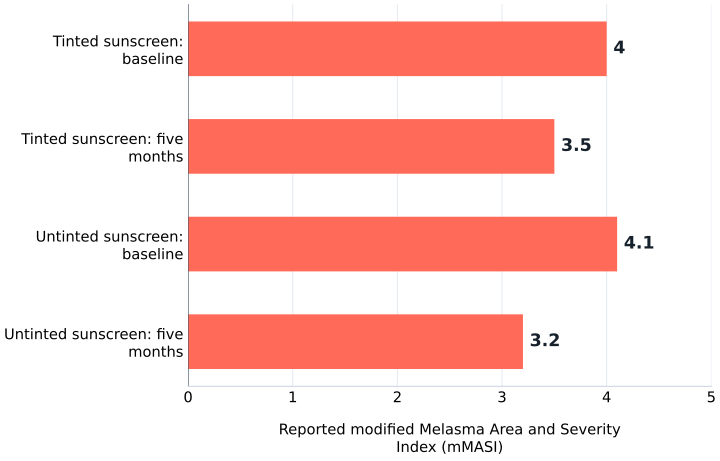
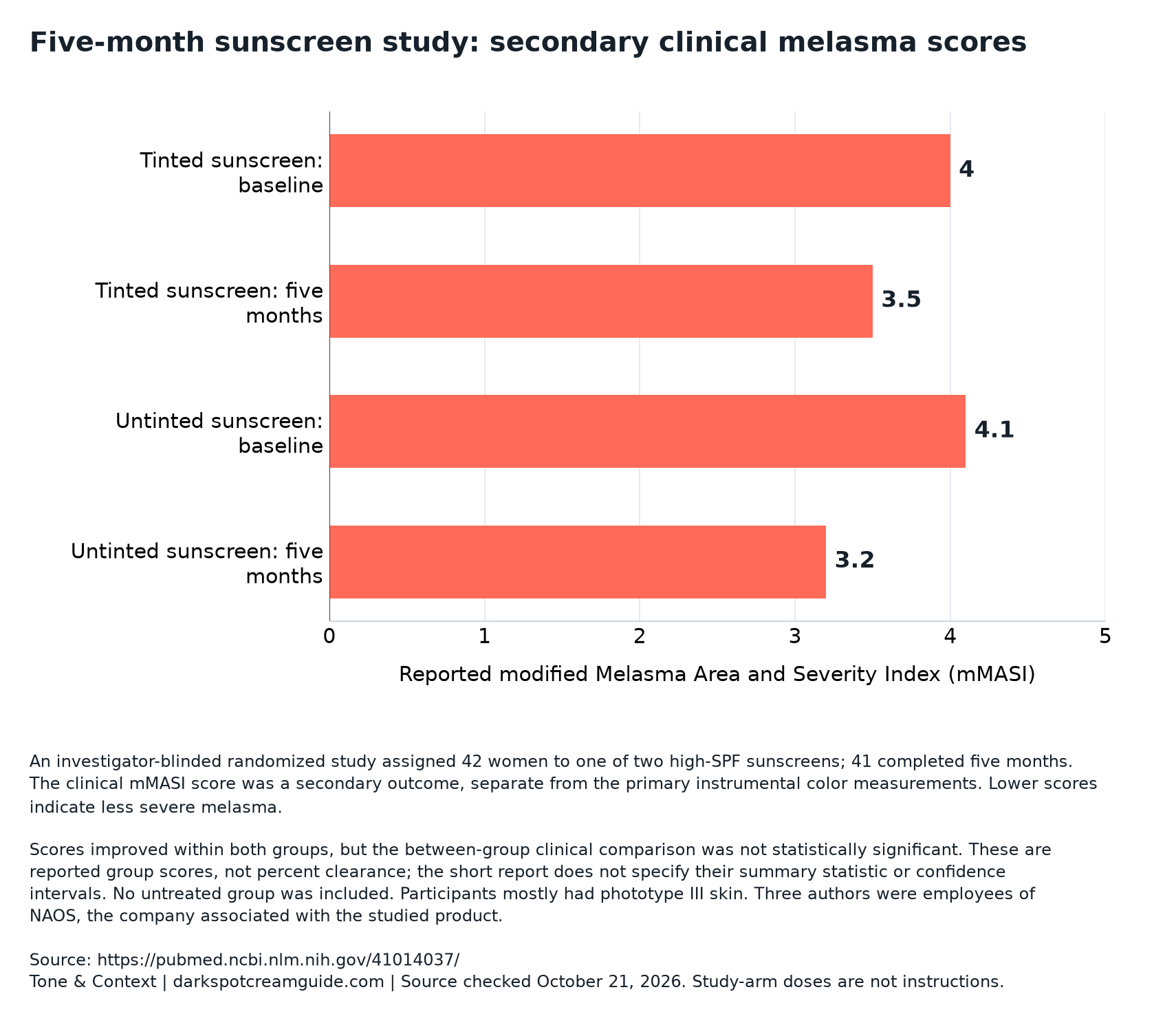
Reported mMASI scores were 4.0→3.5 (tinted) and 4.1→3.2 (untinted). Both within-group P values were <0.001; the between-group difference was nonsignificant. The summary statistic was unspecified. Our graphic therefore presents group scores without assigning an unsupported summary statistic.
As an arithmetic observation, subtracting the follow-up value from baseline gives declines of 0.5 and 0.9 score units. That calculation describes the displayed values; it is not an adjusted treatment-effect estimate. It also does not reveal how many participants improved, how much individuals varied or whether a particular change was noticeable to them. Those questions require information beyond two group-level numbers.
The scale’s units are especially important when a result becomes a headline. A fall of one score unit is neither one person responding nor one percentage point of pigment removed. To state a response proportion, researchers must define a threshold and count people meeting it. To judge clinical importance, readers need a defensible meaning for the size of change. Our interpretation keeps those tasks separate from the simpler task of drawing the reported trajectory.
Summer follow-up cannot answer every question about recurrence
The trial had no untreated arm. Our interpretation of its seasonal setting therefore distinguishes a comparison between products from the hypothetical course without either product. Seeing stability or improvement while people receive an intervention does not reveal the outcome they would have had without it. That missing comparison cannot be supplied by assuming that everyone would otherwise have worsened.
Recurrence introduces a further requirement: the event has to be defined. A study designed around recurrence would need an identifiable initial state, a rule for determining that disease has returned and a period during which that rule is applied. Repeated color readings may inform such work, but they are not automatically a count of recurrence events. Likewise, an assessment at a final visit does not describe every fluctuation between visits.
These distinctions are useful when discussing continuing care after another treatment changes. The guide to maintenance conversations after hydroquinone addresses that separate decision. A study can contribute information about a product used during follow-up without determining a complete maintenance plan. In our reading, the unanswered question is specific: what clinical course, over what period, under what additional care, would establish sustained control for the population of interest?
Different cream trials can use different definitions of success
The sunscreen experiment is not a treatment ranking against prescription creams. The table distinguishes its main measurement from the endpoints in a separate Chinese triple-combination trial and the US Tri-Luma prescribing record. The eight-week triple-combination article examines that separate experiment in detail. Its existence expands the evidence context without creating a direct comparison that was never performed.
The central methodological point is the unit of analysis. A numerical difference between areas, a proportion achieving a defined improvement and a proportion reaching clearance can all be legitimate outcomes. Their values cannot be sorted from largest to smallest as though they measured the same benefit. Even matching units would leave questions about the enrolled population, comparison treatment, timing and handling of missing observations.
Ingredient overlap introduces another source of confusion. The labeled Tri-Luma formula combines hydroquinone 4%, tretinoin 0.05% and fluocinolone acetonide 0.01%. Those concentrations identify a specific combination, not a schedule for self-treatment. An inference about hydroquinone alone or another compounded mixture needs its own support. Our hydroquinone guide provides further context for keeping the ingredient, the prescription product and the purpose of treatment connected.
Different evidence records define outcomes differently; their numerical results do not form a shared effectiveness scale.
| Evidence record | Endpoint discussed | Unit or threshold |
|---|---|---|
| Sunscreen comparison | Primary colorimetry | Instrumental pigmentation measurements. |
| Chinese triple-combination trial | Primary severity improvement | Two- or three-grade decrease on MSS. |
| US Tri-Luma label trials | Treatment success | MSS rating of zero: cleared. |
Tolerability needs to remain separate from efficacy
Both sunscreens were described as well tolerated; comparative adverse-event counts were not supplied. Our interpretation treats that as a limited safety observation rather than a numerical risk estimate. Without event counts and the relevant denominator, a reader cannot calculate a frequency. Without details about assessment, it is also difficult to compare the statement directly with another trial’s safety table.
This distinction matters because efficacy and tolerability require different observations. A product could change a pigmentation measure while causing discomfort, or feel acceptable while producing little detectable clinical change. Neither possibility is an allegation about these participants. They illustrate why a favorable finding in one domain should not silently fill an information gap in the other. Both domains deserve explicit definitions and appropriate follow-up.
Prescription warnings must also retain their product identity. The Tri-Luma label includes irritation, hypersensitivity, ochronosis and possible systemic corticosteroid effects. These are not sunscreen event rates. The label describes short-term use for moderate-to-severe facial melasma and does not designate the medicine for maintenance. In our interpretation, bringing those records together should improve a clinician-led conversation about roles and precautions, rather than transfer one product’s risks or indications to every cream discussed alongside it.
Disclosure and completeness help identify the next research question
Three authors disclosed current or former NAOS employment, and Thierry Passeron reported industry honoraria. The study was funded by NAOS Ecobiology Company, Aix-en-Provence, France. Final completion counts by arm were unreported. The funding and relationships around the research are documented; the final participant distribution is a separate information gap and should not be filled with a confident guess.
Our interpretation of commercial involvement focuses on questions a reader could investigate: who selected the outcomes, who analyzed the data, and what access would permit independent scrutiny? An author’s employer does not answer all of those questions. At the same time, disclosure is relevant context and should remain visible. A critical reading can acknowledge the documented relationship while assessing the actual design and results.
For further research, the useful objective would be stronger inference rather than merely a larger collection of photographs. A prospectively defined clinical difference, a suitable comparison and transparent handling of incomplete observations would make the findings easier to interpret. Reporting both instrumental changes and participant-relevant outcomes could clarify whether they move together. These are proposed improvements in evidence, not features we assume were present or absent in the study’s unavailable supplementary detail.
The next product question should be specific enough to answer
FDA warns that OTC hydroquinone skin-lightening products lack approval for safety and effectiveness and describes reports of rash, facial swelling and potentially permanent ochronosis. This notice and the approved prescription Tri-Luma label concern different regulatory records. Neither settles the status of an unspecified compounded preparation or establishes mercury contamination in any untested product.
Our editorial interpretation is to identify the missing link before comparing offers. Is the question about which formula is dispensed, which outcome has been studied or what happens during follow-up? Documentary reviews of Musely and Dermatica can help a reader inspect service and product terms. These links do not establish that either service provides the study sunscreen or delivers its measured results.
The scientific value of this approach is that it makes the proposed inference visible. A claim about an ingredient asks for ingredient evidence; a claim about a finished cream asks for product evidence; a promise about a person’s future course requires more than either alone. Tone & Context’s assessment is that a useful explanation should show where those records connect and where a further question remains, without replacing an individual clinical discussion with a list of trial numbers.
Questions about the evidence
Does sharing a pigment ingredient make two sunscreens equivalent?
It provides a reason to investigate their relationship, not an equivalence result. Our formulation interpretation asks whether the finished products and relevant performance measurements match. A component name cannot supply missing clinical comparisons, and an experiment on one preparation should remain attached to that preparation when its findings are discussed.
Why display the clinical scores if colorimetry was the main endpoint?
The two records help a reader see which question each measurement addresses. A secondary clinical assessment can provide context without replacing the primary analysis. Its proper role depends on its definition and uncertainty, so a graphic should identify the outcome and preserve the report’s terminology rather than suggest an overall winner.
Would a larger decline automatically mean one product worked better?
A numerical contrast needs a suitable statistical comparison and a clinically interpretable scale. Starting values and uncertainty matter. The arithmetic difference between two displayed changes is informative about the chart, but it does not by itself establish the size or reliability of a treatment effect.
Can the sunscreen result be compared directly with a clearance percentage?
No common ranking follows from those different units. Clearance is a defined clinical state, while a color measurement describes an optical observation. Our interpretation first identifies what was measured, then asks whether the comparison, population and timing would support any further connection between the studies.
What should a reader take to a follow-up discussion?
A precise question about the diagnosis, the exact product and the intended outcome is more useful than an isolated ingredient percentage. Our editorial suggestion is to identify which part of that record remains unclear. The evidence can then support a focused discussion without supplying a personal prescription or a guaranteed result.
What this evidence supports
This study is useful for learning how formulation evidence and outcome evidence fit together. Our assessment preserves their separate roles: optical protection characteristics describe the tested cream, instrumental measurements describe skin observations, and a clinical scale provides another view of the condition. None of those records automatically supplies the others. A careful product explanation should retain the comparison, population and time frame, then identify the additional evidence needed for a broader claim. That approach lets readers recognize a potentially informative finding while keeping its meaning proportionate to what was actually measured.
Research access and limitations
The analysis draws on the full short sunscreen report, the separate full Chinese triple-combination article, official Tri-Luma labeling and FDA’s consumer notice. Sunscreen supplementary material and numerical figure estimates were not independently evaluated. No confidence intervals or individual outcomes have been reconstructed. Interpretive examples and research proposals are editorial reasoning, not additional patient data.
THE SOURCE MATERIAL
Read the originals.
Source retrieval dates appear with each record below. A commercial page supports offer details; it does not independently validate the treatment claims.
- DailyMed — TRI-LUMA prescribing information ↗
Product-specific label for short-term treatment of moderate-to-severe facial melasma with sun-avoidance measures. Not evidence for every hydroquinone mixture.
Source checked: 2026-10-21
- Efficacy and Safety of Generic Fluocinolone Acetonide, Hydroquinone, and Tretinoin Cream Compared With TRI-LUMA for the Treatment of Moderate-To-Severe Melasma in Chinese Patients: A Randomized, Single-Center, Placebo-Controlled Trial. ↗
Full research article, with indexed abstract where available
Source checked: 2026-10-21
- Comparison of Visible Light-Protective Tinted Sunscreen to Untinted Sunscreen to Protect Melasma Patients During Summer: A Prospective Randomized Investigator-Blinded Study. ↗
Full primary research letter plus verified PMC funding footnote; supporting-information document and figure-derived numerical data not reviewed
Source checked: 2026-10-21
- FDA warns consumers of skin products containing mercury and/or hydroquinone ↗
Current FDA consumer safety notice, introductory safety text read; individual product-testing table is not used for provider comparisons.
Source checked: 2026-10-21